


Website ROI Explained: How to Measure Growth and Value – Pixelcarve
Why Website ROI Is the Key to Smarter Digital Investment


Your website should be a growth engine, not a budget drain. Yet for many brands, that’s not the reality. According to Business Dasher, businesses that actively use their websites to engage customers see 15–50% revenue growth over those that don’t. That’s a gap you can’t afford to ignore.
Curtis Priest, CEO of Pixelcarve, in a post on why real estate developers lose buyers, noted that: “it’s not because of the market, and not because of the product. It’s because their digital presence doesn’t reflect the quality, vision, or value of the development.”
He further added, “Today, a website isn’t just a brochure. It’s the first pitch, the trust builder, and the 24/7 sales engine.”
In this blog, you’ll learn:
- What website ROI really means
- How to measure it with clarity and precision
- How to keep it growing, year after year
Let’s turn your site into a strategic asset that drives measurable results.
What Is Website ROI and Why Does It Matter?
Website ROI, return on investment, is the clearest measure of how much value your site generates for your business compared to how much it costs you. Forget the spreadsheets! This measure tells the real indicator of your performance
For example, if your site’s running cost is $10,000 annually and generates $50,000 in revenue, your ROI is 400%. But ROI is more than a number. It’s proof that your website is driving growth, not just sitting online as a digital brochure.
Why does this metric really matter? A strong ROI reveals that your site is evolving with your business goals. When you treat your website as a performance channel, you unlock its potential to scale with you.
That mindset makes all the difference.
| Build a Website That Pays for Itself! Invest smart. We’ll show you how website ROI proves performance and drives future growth. Learn More |
How to Calculate Website ROI: A Practical Walkthrough
Website ROI is a reflection of how well your site converts traffic into revenue. To calculate it accurately, you need more than just top-line numbers. You need to understand the full journey from visitor to profit.
The Core Formula
ROI = (Revenue – Cost) ÷ Cost × 100
This tells you how much return you’re getting for every dollar invested. But to make this formula meaningful, you need to plug in the right numbers, based on your actual performance.
Step-by-Step ROI Breakdown for Businesses
Let’s walk through the five key metrics you’ll need to calculate your website’s ROI:
1. Website Traffic
Use Google Analytics to find your average monthly visitors. Formula: Total Visitors ÷ Total Months = Monthly Traffic
2. Conversion Rate
Track how many visitors take action, including form submissions, calls, downloads, etc.
Formula: Conversions ÷ Monthly Visitors = Conversion Rate
3. Closing Ratio
Determine the number of leads that turn into actual sales.
Formula: Signed Contracts ÷ Proposals = Closing Ratio
Then calculate: Monthly Website Leads × Closing Ratio = Monthly Events
4. Average Sale
Find your average revenue per event. Formula: Total Sales ÷ Total Events = Average Sale
5. Gross Profit Per Event
Subtract your average cost of goods sold (COGS) from your average sale.
Formula: Average Sale – COGS = Gross Profit per Event
Let’s say your website generates 10 new events per month, each worth $1,000 in gross profit. That’s $10,000/month in attributed revenue.
If your website costs $30,000 to build and maintain, you’ll break even in just three months. Everything after that is pure profit.
ROI = (120,000 – 30,000) ÷ 30,000 × 100 = 300%
That’s a 3x return or $3 earned for every $1 invested.
Some companies use gross profit to calculate ROI, while others prefer net profit to include fixed costs. Choose the model that best reflects your financial goals, but be consistent.
The Real Costs to Consider for Website ROI Measurement
Most brands underestimate their website costs, and that leads to distorted ROI calculations. Design and development are just the beginning. To measure performance honestly, you need to account for every moving piece.
Here are the full cost categories that shape your ROI:
- Design & Development: This is your upfront investment. It includes creative direction, UX design, and custom development, all of which lay the foundation for performance and scalability.
- Hosting, Security & Maintenance: Ongoing costs matter. Downtime, security breaches, or slow load times can erode trust and tank conversions. Reliable infrastructure is essential for stability and user experience.
- Tools, CRM, Analytics & Integrations: ROI has more to do with how you capture and manage leads. Subscription-based systems such as CRMs, analytics dashboards, and chat tools must be factored in.
- SEO & Marketing Support: A website that nobody sees has zero ROI. Ongoing SEO, paid search, and digital campaigns are operational investments that drive visibility and results.
Skipping these costs may make your ROI look better on paper, but it gives you the wrong picture. To measure performance with integrity, you must count every dollar that fuels your site’s success.
Direct vs Indirect Returns of Website ROI
Website ROI changes shape depending on how your business runs. To measure it meaningfully, you need to understand where your revenue connects and how your site contributes to the customer journey.
1. E-Commerce Websites
Here, the path is clear. Purchases are directly tied to your site. Metrics like cart value, conversion rates, and abandoned carts show exactly where money flows, and where it leaks.
2. B2B Websites
Attribution is more complex. Decisions stretch across months, involve multiple stakeholders, and rarely come to an end with a single click.
In this case, your website’s value lies in qualification, including educating prospects, nurturing leads, and providing touchpoints that shape eventual deals.
4. Brand-Focused Websites
Even without direct sales, a strong brand site delivers ROI. It builds trust, strengthens retention, and enhances the customer journey through FAQs, resources, and digital service tools.
Your role is to define the right attribution model for your reality. At the end, the way you measure determines how you value your site and how you invest in its future.
| “If your website hasn’t been touched in 6+ months, it’s not an asset, it’s a liability. Too many businesses launch a site and walk away, thinking the job is done. Meanwhile, your customers, competitors, and the algorithms are all evolving.” Curtis Priest CEO of Pixelcarve |
Website Redesign ROI: When to Reinvest in Your Site
Every website has a shelf life. Technology evolves, design trends shift, and user expectations rise. At some point, your ROI begins to fall, and that’s your signal to reinvest.
Here are clear signs it’s time for a redesign:
- Slow Site Speed: Your revenue Speed is directly tied to speed. Just seconds of delay can reduce conversions by up to 7%, according to Akamai.
- Poor User Experience: Confusing navigation, outdated layouts, or broken mobile responsiveness drive users away before they convert.
- Low Conversions: If your traffic is steady but leads are flat, your design may be the barrier. A frictionless experience turns visitors into customers.
A redesign isn’t cosmetic; it’s about performance. For example, eBay cut page load times by 12% and saw a 0.5% lift in “Add to Cart” conversions. Reinvesting in your site realigns your digital presence with modern expectations and positions your brand for stronger returns.
| More articles you might like: The Importance of Website Security The Hidden Cost of Neglecting Your Website Website Structure Analysis: How to Visualize your New Website |
Setting KPIs That Connect to Website ROI
ROI on its own is abstract. To make it actionable, you need key performance indicators (KPIs) that link site behavior to business outcomes. These metrics turn your website into a measurable growth engine.
Here are the essential KPIs to track:
- Lead Volume: Measure the number of new leads coming in monthly, via forms, phone calls, downloads, or chat interactions. This reveals how well your site attracts and activates interest.
- Conversion Rates: Track the percentage of visitors who take meaningful actions, like signing up, requesting a demo, or making a purchase. This reflects how persuasive and frictionless your site experience is.
- Engagement Metrics: Time on site, bounce rate, and content downloads reveal how much value your site delivers. High engagement signals relevance and trust.
- Sales Growth: This is the clearest link between ROI and business impact. If your site contributes to rising revenue, it’s doing its job.
The real power comes from alignment. Once you define the right KPIs, every improvement, whether in design, content, or functionality, can be traced back to ROI. That’s how you turn your website into a performance channel, not just a digital placeholder.
Strategies to Improve Your Website ROI
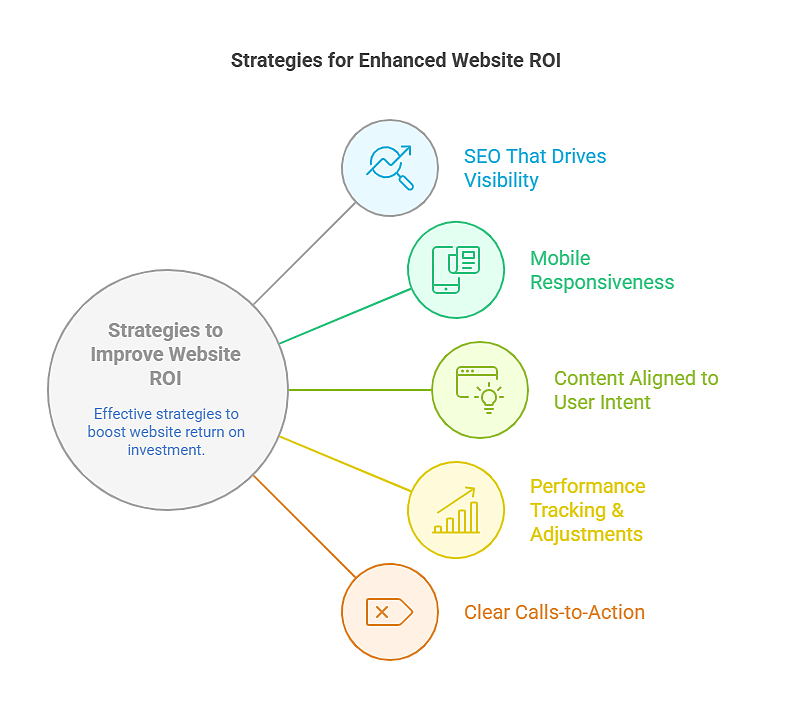
If your website ROI feels flat, don’t panic; you have levers you can pull immediately. These strategies connect your site more directly to growth, turning passive pages into performance assets.
- SEO That Drives Visibility: Search visibility brings qualified traffic. By targeting keywords that match user intent, you attract visitors who are already looking for solutions, making conversions more likely.
- Mobile Responsiveness: By Q2 2025, mobile phones drove 62.54% of all global website traffic. If your site isn’t fluid across devices, you’re losing most of your audience before they even engage.
- Content Aligned to User Intent: Blogs, guides, and case studies that answer specific questions build trust and authority. When content solves problems, it becomes a sales tool, not just filler.
- Performance Tracking & Adjustments: Metrics reveal what’s working and what’s not. Continuous optimization keeps ROI growing instead of stagnating.
- Clear Calls-to-Action: In Curtis Priest’s’ words, “Don’t just place your CTA – stage it! Like the climax of a great movie, everything on the page should build toward that one moment.” Whether it’s a purchase, form fill, or download, clarity equals results.
Each of these strategies strengthens the connection between your site and your business goals. That’s how ROI builds momentum and how your website becomes a growth engine.
Using a Website ROI Calculator to Stay Accountable
A website ROI calculator is a practical tool for staying honest with your numbers. Instead of relying on loose estimates or gut feelings, you plug in real costs and project realistic revenue targets.
Calculators like this make accountability visible. They also turn investment conversations from subjective to strategic, giving you a clear view of what’s working and where to improve.
Building a Performance-First Mindset
ROI evolves with your strategy. Brands that outperform are those that measure, adapt, and refine continuously. Your website should be a performance engine. When you treat it that way, you align digital spend with real outcomes, and that’s how you scale in a competitive market.
Key Takeaways to Improve Website ROI Today
Website ROI proves your website is a business asset, not just a budget line item.
Core Formula & Costs
Use the full equation: (Revenue – Cost) ÷ Cost × 100. Include all investments, design, hosting, tools, and marketing to get a real number.
KPIs That Tie to ROI
Track metrics that reflect performance:
- Lead volume
- Conversion rates
- Engagement (time on site, bounce rate)
- Sales growth
Strategies to Improve ROI
Pull the right levers:
- SEO that drives visibility
- Mobile-first design
- Content aligned to user intent
- Performance tracking
- Clear calls-to-action
Tools to Simplify
Use a website ROI calculator to stay accountable and make your investment conversations data-driven.
Comparing ROI Metrics Across Website Types
Not all websites create ROI in the same way. Here’s a table showing how ROI drivers differ. Before reviewing it, note this: knowing your website type clarifies which metrics matter most and where to focus improvement.
| Website Type | Primary ROI Driver | Common KPIs | Typical Cost Focus |
| ECommerce | Direct sales | Conversion rate, cart size, orders | Hosting, UX design, payment tools |
| B2B Lead Gen | Pipeline contribution | Form fills, MQLs, SQLs, deals closed | Content, CRM, automation tools |
| Brand / Corporate | Reputation and retention | Time on site, downloads, inquiries | Messaging, design refresh, content |
| Service Delivery | Efficiency and customer support | Reduced service calls, FAQ use, CSAT | Automation, integrations, support |
This framework helps you choose ROI goals that fit your digital reality, not someone else’s.
Drive Growth with Pixelcarve
Your website is the most powerful digital channel you own. But power means nothing without performance. Measuring website ROI gives you the proof and the push to make it work harder.
Pixelcarve brings over 27 years of experience helping premium brands build sites that convert. With recognition from the Webby Awards, the Legal Marketing Association, the International Academy of Arts and Sciences, the Davies, Horizon Awards, among others, our results speak for themselves.
If you want a website that works as hard as you do, it starts here. Contact us today to schedule your consultation and discover how your site can drive measurable growth.
- Website Maintenance Checklist Every Premium Site Needs in 2026 – Pixelcarve
- Top Down vs Bottom Up Designs and What They Mean for You – Pixelcarve
- Web Design Guidelines That Improve User Experience and Accelerates Business Growth – Pixelcarve
- The Ontario WordPress Advisory Is a Good Reminder: Websites Need Ongoing Care
- Website Maintenance Cost Guide for Small and Large Sites – Pixelcarve
